Multiplying Permutations with String Diagrams
This post was originally a Twitter thread replying to Annie Perkins’s #MathArtChallenge Day 54: Permutations.
[L]et’s talk about multiplying two permutations. I’ll use the example from Wikipedia, where our two permutations are P=24135 and Q=54321.
We can think about these permutations as functions that move around a set of five objects: P moves the first object to the second position, the second object to the fourth position etc. So another way to represent P would be its two-line notation
12345
24135.
And Q is
12345
54321
Multiplying P and Q can be thought of as applying the P function then applying the Q function. So P moves object 1 to position 2 and Q moves it from position 2 to position 4.
All in all, P then Q takes
1->2->4,
2->4->2,
3->1->5,
4->3->3,
5->5->1,
which means Q*P=42531. Here we’re writing the product in the “reverse” order, just like we write g(f(x)) for the composition that first applies f then g.
(It’s important to note that permutations don’t commute, so P*Q is not the same as Q*P)
OK. Now for the string diagrams. Above we discussed the two-line notation for permutations. Instead of putting 12345 on the top and the one-line permutation on the bottom, put 12345 on the top and 12345 on the bottom and connect the origin and destination placements with a line.
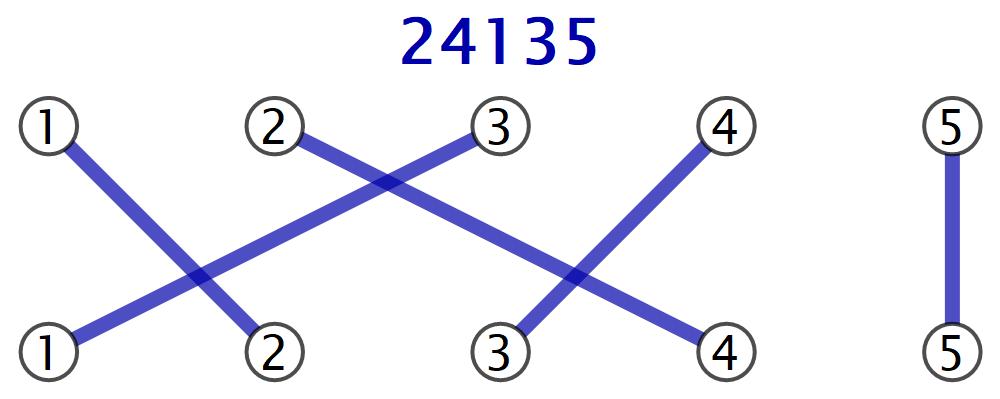
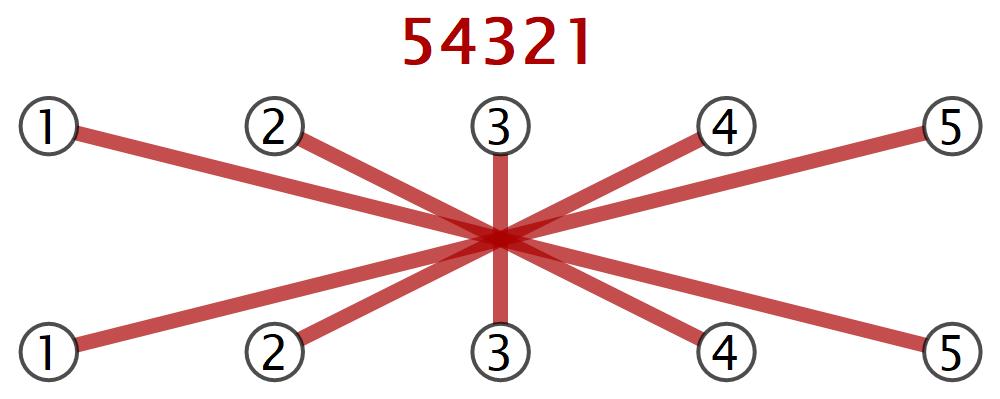
Because both P and Q have the top and bottom in the order 12345, we can multiply Q*P by putting P on top of Q and following the strings to see that Q*P=42531. (The string that starts at 1 ends at 4, 2->2, 3->5, 4->3, 5->1.)
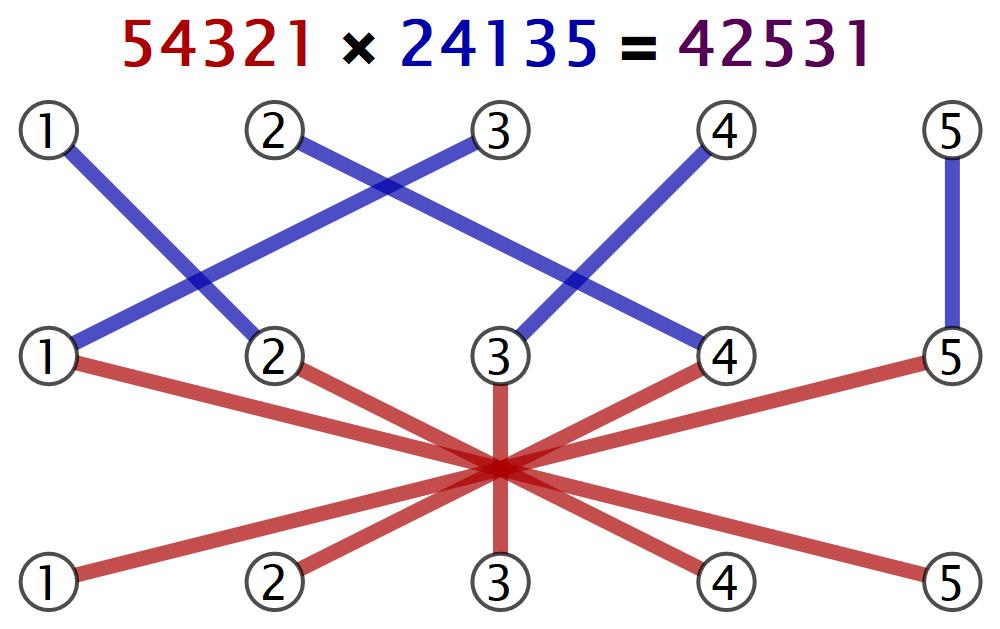
I love how much more visual the whole process is.🙂
Citation
@online{hanusa2020,
  author = {Hanusa, Christopher R. H.},
  title = {Multiplying {Permutations} with {String} {Diagrams}},
  date = {2020-05-10},
  url = {https://hanusa.xyz/blog/posts/2020-05-10-multiplying-permutations-with-string-diagrams/},
  langid = {en}
}