Permutations corresponding to sequences of reflections.
In a recent Google+ post, I shared an animation that sliced a tetrahedron along the six planes of symmetry and casually mentioned that the 24 colored regions corresponded to the permutations of \(\{1,2,3,4\}\).
Here is a new animation that highlights the appearance of permutations of \(\{1,2,3,4\}\).
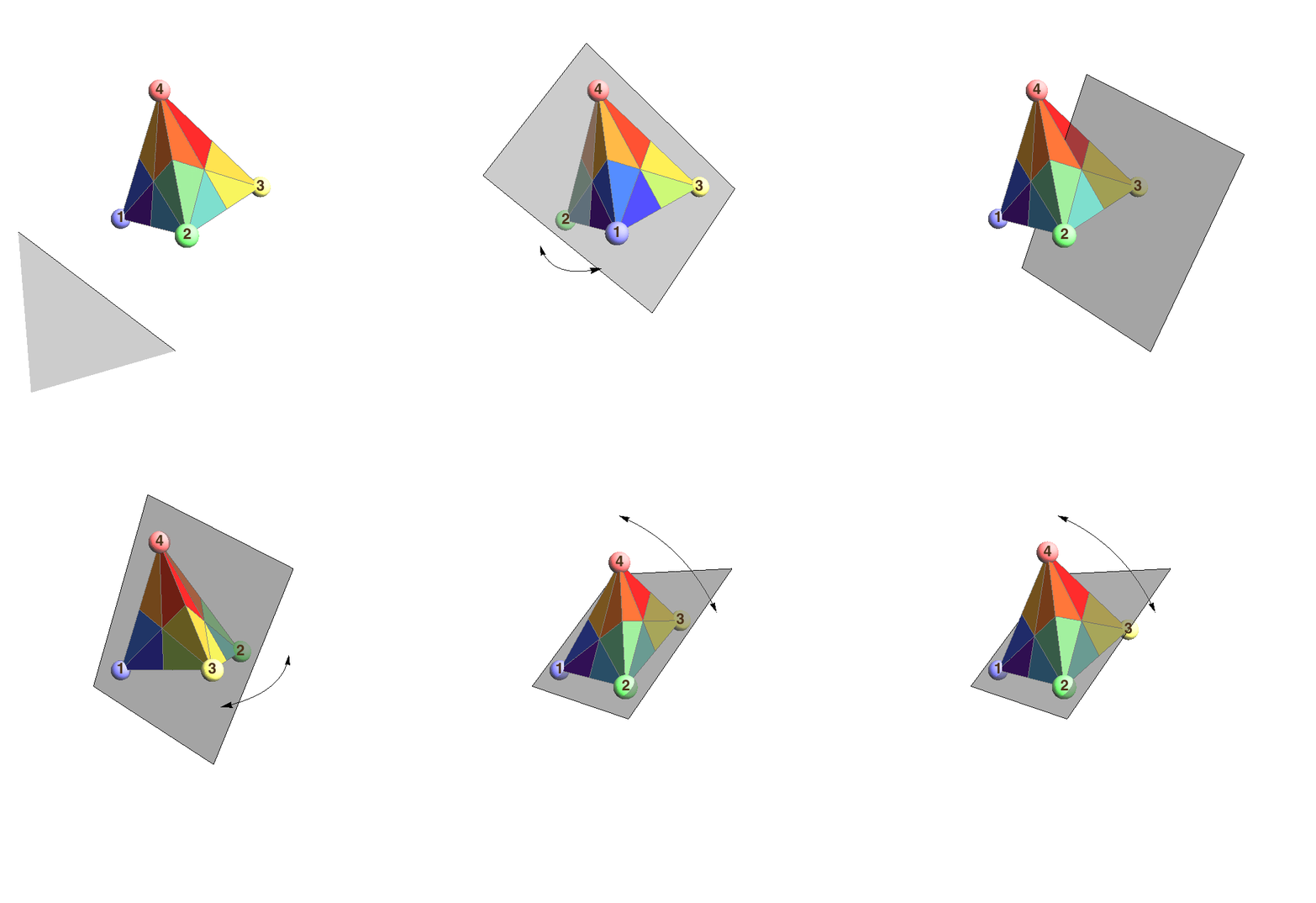
We label the four vertices of the tetrahedron by the numbers \(1\), \(2\), \(3\), and \(4\). When we do this, we see that any automorphism of the tetrahedron reorders the labels of the vertices, which is simply a permutation of \(\{1,2,3,4\}\). (I use the technical term “automorphism” to mean any way to rotate or reflect then rotate the tetrahedron and get back the same shape afterward.)
In the animation above, I highlight three special reflections:
\(R_1\): The transposition of vertices 1 and 2
\(R_2\): The transposition of vertices 2 and 3
\(R_3\): The transposition of vertices 3 and 4
They are special because every permutation of \(\{1,2,3,4\}\) can be generated by a sequence of these reflections. For example, if we apply the reflection \(R_1\) first, then \(R_2\) second, and then \(R_3\) third, this corresponds to starting with \(1234\), switching the first two positions to get \(2134\), then switching the two middle positions to get \(2314\), and finally switching the last two positions to get \(2341\). So we might write that the product \(R_1\cdot R_2\cdot R_3\) equals the permutation \(2341\).
Of course this equality depends on your convention for the order in which you multiply elements, left to right or right to left, and that is a post for another time.
Citation
@online{hanusa2013,
  author = {Hanusa, Christopher R. H.},
  title = {Permutations Corresponding to Sequences of Reflections.},
  date = {2013-10-30},
  url = {https://hanusa.xyz/blog/posts/2013-10-30-permutations-corresponding-to-sequences-of/},
  langid = {en}
}